Geometry Dash: Inside the One-Button Rhythm Obsession
Geometry Dash turns one tap into an obsession: how the rhythm platformer works, why dying 4,000 times feels fair, and why its level editor still hums.
A square, a beat, and no second chances
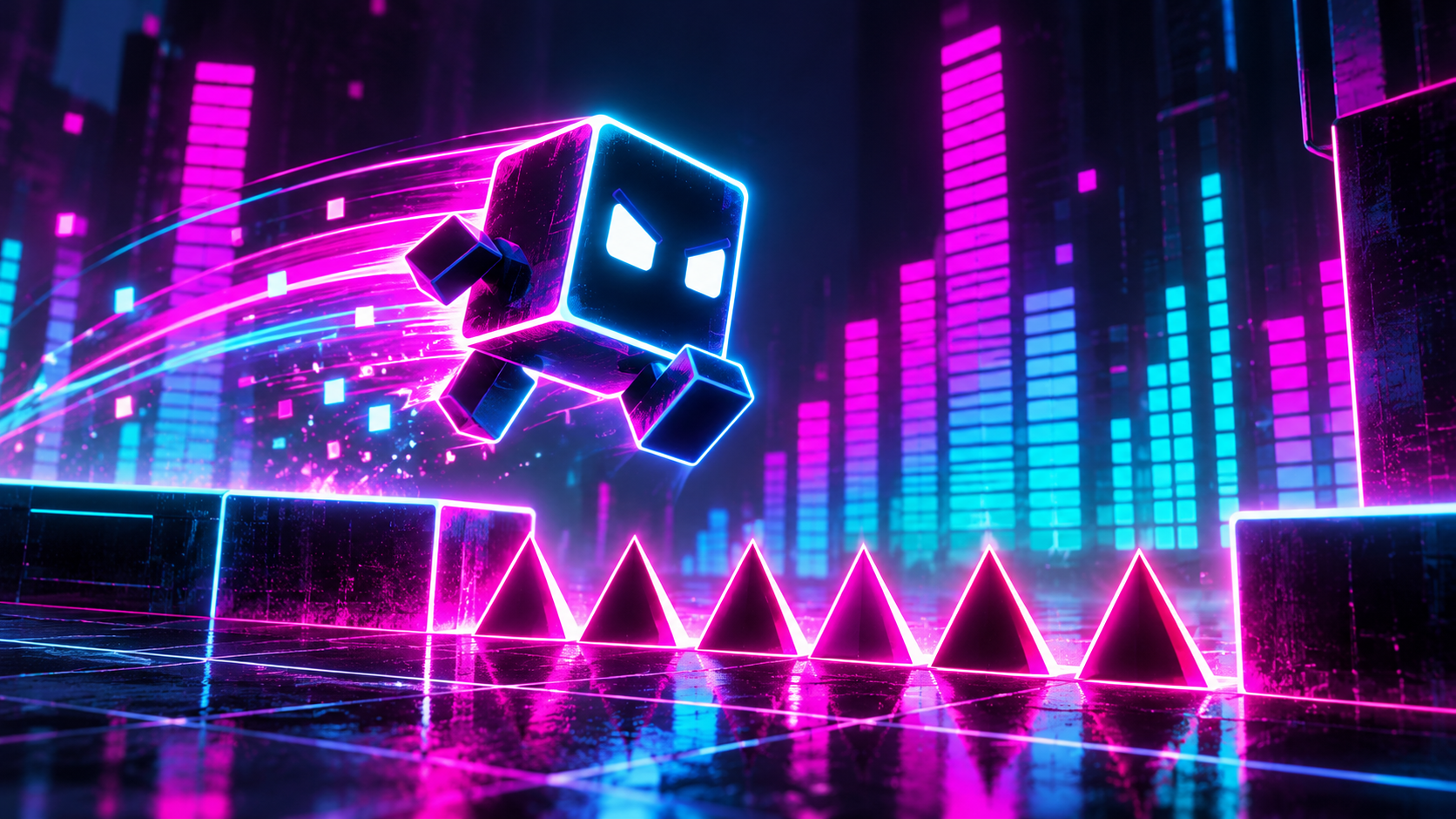
Geometry Dash is a rhythm platformer built around a single input. Your icon — usually a square with a face — runs forward on its own. You tap, click or hold to jump, and the level scrolls whether you are ready or not. Clip one spike or mistime one hop, and the run ends instantly. Then it starts again, almost before your thumb has lifted.
That loop has kept players hooked since Swedish developer Robert Topala, working as RobTop Games, released the game for iOS and Android in 2013, followed by a Steam version in 2014. More than a decade on, it still draws enormous audiences on mobile and PC — less because of new official content than because of a level editor that lets players build and publish their own stages.
How the game actually works
Every level is synchronized to an electronic soundtrack. Obstacles are placed on the beat, and your jump arc is fixed: the same tap in the same spot always produces the same result. That predictability is the whole design. Geometry Dash is not really a game of reflexes; it is a game of memorization, rhythm and nerve, where a level you cannot survive on attempt ten becomes routine by attempt two hundred.
Eight modes, one thumb
The base cube is only the beginning. Levels switch between modes mid-run, each with different physics: the ship floats while you hold, the ball flips gravity on every tap, the UFO gives mid-air taps, and the wave turns a held button into a diagonal laser. Robot, spider and swing — the last added in the long-awaited 2.2 update in late 2023 — round out a set that makes one button feel like eight different games.
Practice mode and the attempt counter
A practice mode lets you drop checkpoints and learn a route without losing your mind. Meanwhile the game quietly counts everything: attempts, jumps, time spent. That attempt number becomes a badge of honor in the community. Screenshots reading "4,812 attempts" are not a confession of failure; they are a trophy.
The difficulty ladder
Official levels step up through named tiers, from Easy to Insane, and the hardest community levels sit in the Demon category, itself split into Easy, Medium, Hard, Insane and Extreme Demon. Clearing levels earns stars and secret coins that unlock cosmetics, giving completionists a reason to revisit stages they have already beaten.
What makes the ecosystem unusual is verification. To publish a level, a creator generally has to beat it themselves, and for the hardest custom stages that can mean weeks of grinding. Top players race to verify fearsome levels first, and those runs become events watched live by thousands.
Why dying thousands of times still feels fair
- Restarts are instant. No loading screen, no walk-back, no lost progress — just another attempt.
- Deaths are legible. You almost always know exactly what killed you, which turns rage into a plan.
- Levels are short. Most last one to two minutes, so a full run is always within reach.
- The music carries you. A good soundtrack doubles as a metronome and a reward, making repetition less tedious than it sounds.
- Progress is visible. Percentage counters tick upward and mark exactly how far you have pushed.
That combination produces the "one more try" effect that designers study and players complain about happily at 1 a.m. Because failure costs seconds rather than hours, the brain treats each attempt as cheap — and keeps spending.
The level editor is the real long tail
Official levels are a tutorial compared with what the community builds. Shared by ID, rated by stars and sorted by difficulty, custom levels range from gentle warm-ups to absurd gauntlets that only a few dozen people on Earth have finished. Creators layer art, custom backgrounds, triggers and camera tricks on top of gameplay, and the best levels look less like a mobile game and more like choreographed light shows.
The social layer lives mostly off-platform: YouTube uploads, Twitch streams, Discord servers and subreddits where players argue about rankings and celebrate first completions. For a game with no live chat lobbies, its community is remarkably loud.
What parents should know
- It is a paid game, not a slot machine. The full version is a one-time purchase with no energy timers, loot boxes or ad interruptions; the free Lite version is the ad-supported one.
- The content is user-generated. Difficulty varies wildly, but themes stay abstract — spikes, blocks and neon.
- Flashing lights and fast motion are constant, so photosensitivity is worth considering.
- The wider community is elsewhere. Moderation matters most on the video and chat platforms where players gather, not inside the game itself.
Tips for getting better without wrecking your thumb
- Play with sound on. The beat is the map.
- Learn a level in practice mode first, then run it clean.
- Drill short segments instead of full attempts when one section keeps killing you.
- Keep sessions short — muscle memory consolidates between runs, not during them.
- Respect the ladder. Jumping straight to Extreme Demons is how people quit.
The bottom line
Geometry Dash has lasted because it does one thing almost perfectly: it makes failure cheap and mastery visible. A single button, a fixed jump arc and a song you can hum are enough to turn a two-minute level into an evening. Whether you are chasing your first Demon or just trying to survive Stereo Madness, the appeal is the same — the next attempt is always the one.