Solitaire: Why the Classic Card Game Still Wins
From Windows desktops to phone screens, solitaire remains a daily ritual for millions. Here's why the classic card game endures, and how to play it smarter.
Why Solitaire Never Really Went Away
Long before battle passes and daily logins, there was a simple deck of cards and a window of green felt. Microsoft bundled Solitaire with Windows 3.0 in 1990 — partly as entertainment, partly to teach new users how to drag and drop with a mouse. Three decades later, solitaire is still one of the most-installed casual games in the world, sitting quietly in phone app drawers and browser tabs everywhere.
That longevity is unusual. Most games age out. Solitaire didn't, and the reason says a lot about what makes a casual puzzle game stick.
What Solitaire Actually Means
"Solitaire" is not one game — it is a family of patience games played by a single person. Hundreds of variants exist, but a handful dominate the conversation:
- Klondike — the version most people picture: seven tableau columns, four foundations, and a stock pile you flip through.
- Spider — played with 104 cards across ten columns, building descending sequences until whole suits collapse and clear.
- FreeCell — all 52 cards are dealt face-up into eight columns, with four "free cells" as temporary holding spots.
- Pyramid and TriPeaks — quicker, more arcade-like layouts where pairs or sequences clear the board.
Each has its own rhythm. Klondike is a slow build, Spider is a long grind, FreeCell is a pure logic puzzle, and Pyramid is a snack.
The Rules of Klondike, in One Breath
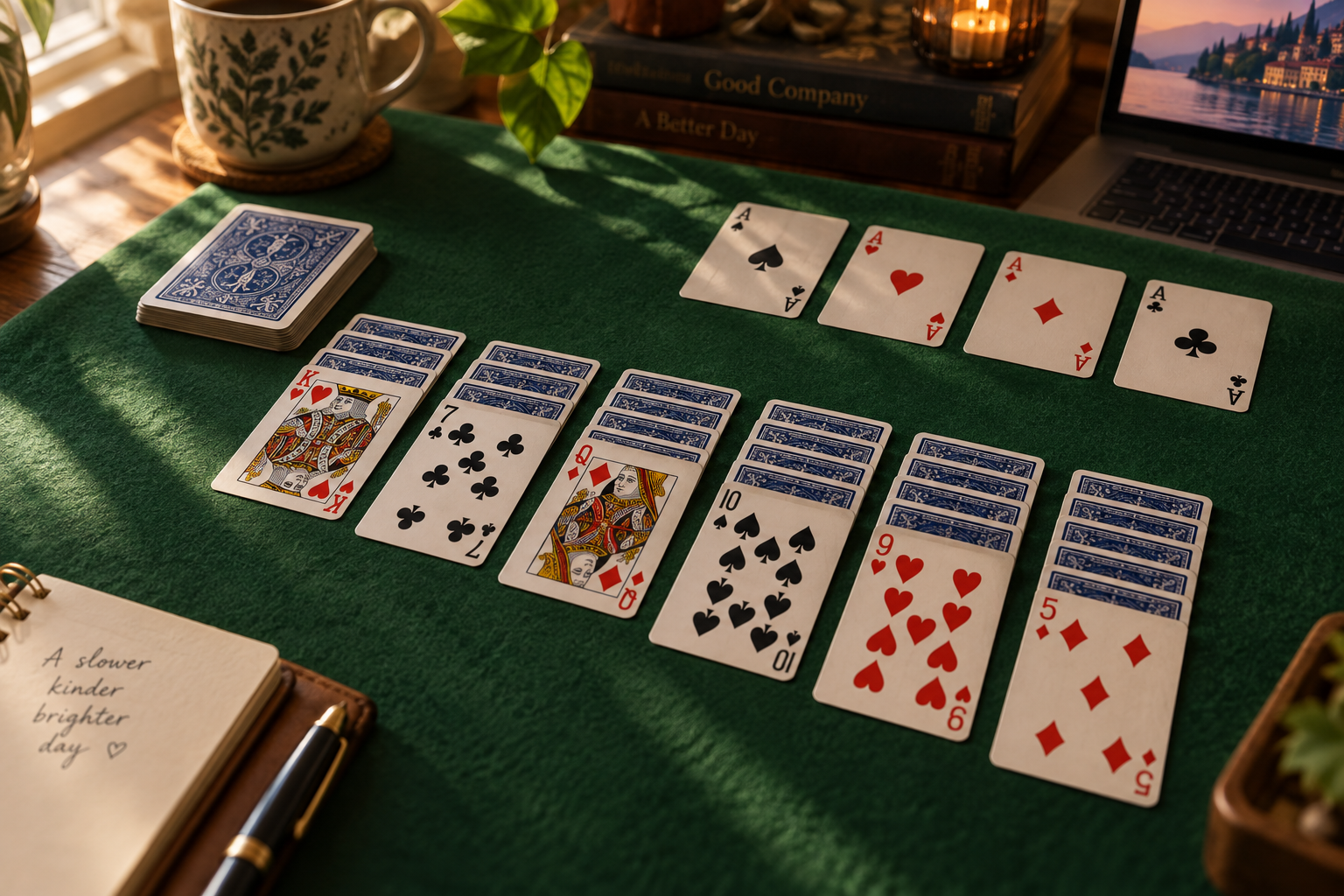
Shuffle a standard 52-card deck. Deal seven columns: the first gets one card, the second two, and so on up to seven. Only the top card of each column is face-up. The remaining cards form the stock.
From there:
- Build down in alternating colours on the tableau — a red six goes on a black seven.
- Build up by suit on the four foundations, starting with each Ace and ending with each King.
- Move Aces and twos to foundations early to free space in the tableau.
- Turn over the stock one card at a time, or three in the harder draw-three mode, and recycle when it runs out.
You win when all four foundations are complete. You lose when no legal move remains — a state that arrives faster than beginners expect.
Skill or Luck? The Honest Answer
Solitaire is often dismissed as mindless, but the numbers tell a different story. In draw-one Klondike, a careful player can win roughly 80% of the deals they are given. In draw-three, that figure drops sharply, because the cards you need may be buried in a rotation you cannot control.
FreeCell is the clearest demonstration of skill dominating chance: of the 32,000 classic Microsoft deals, only one — deal #11982 — was long considered unsolvable. Almost every game is winnable if you plan ahead. The cards do not decide; your sequencing does.
The lesson carries over to every hand: solitaire rewards patience and punishes improvisation. Most losses trace back to a move made three turns earlier.
Why It Still Works on a Phone
Zero commitment
There is no tutorial, no account, no energy meter. You open it, you play, you close it. In a market flooded with games engineered to hold you hostage, that frictionlessness is a feature.
Perfect for idle moments
Solitaire fits the gaps of a day — a queue, a commute, a kettle boiling. A hand takes two to five minutes, and you can abandon it mid-game without penalty.
A strange sort of calm
The loop is repetitive in a satisfying way: flip, sort, stack, repeat. Many players describe it as a fidget toy for the brain — enough focus to quiet a wandering mind, not enough to demand real effort.
Five Habits That Win More Games
- Flip a facedown card before making a tableau move when both options are available. Information beats tidiness.
- Keep columns balanced. Empty columns are powerful, but one deep column is fragile.
- Do not rush Kings into empty columns. Sometimes the empty space is worth more than the King sitting in it.
- Watch the stock count. Knowing how many passes remain changes what counts as a safe move.
- Treat undo as a teacher, not a cheat. In digital versions, replaying a losing position backwards reveals exactly where it went wrong.
Is It Good for Your Brain?
Solitaire will not make you smarter in any measurable, general sense — the evidence for broad cognitive transfer from a single game is thin. What it does offer is practice in planning, working memory, and pattern recognition, plus a low-stakes way to decompress. For older players in particular, the gentle routine of a daily deal is a pleasant, low-friction habit rather than a workout.
There is also a quieter benefit: solitaire is one of the few digital activities with a natural stopping point. A hand ends. You win or you do not. Then you can put the phone down.
The Bottom Line
Solitaire survived because it asked for almost nothing and gave back exactly what it promised: a solvable puzzle, a clean win, and five quiet minutes. In an era of games designed to consume, that restraint is the real trick. Deal the cards, and the rest is up to you.