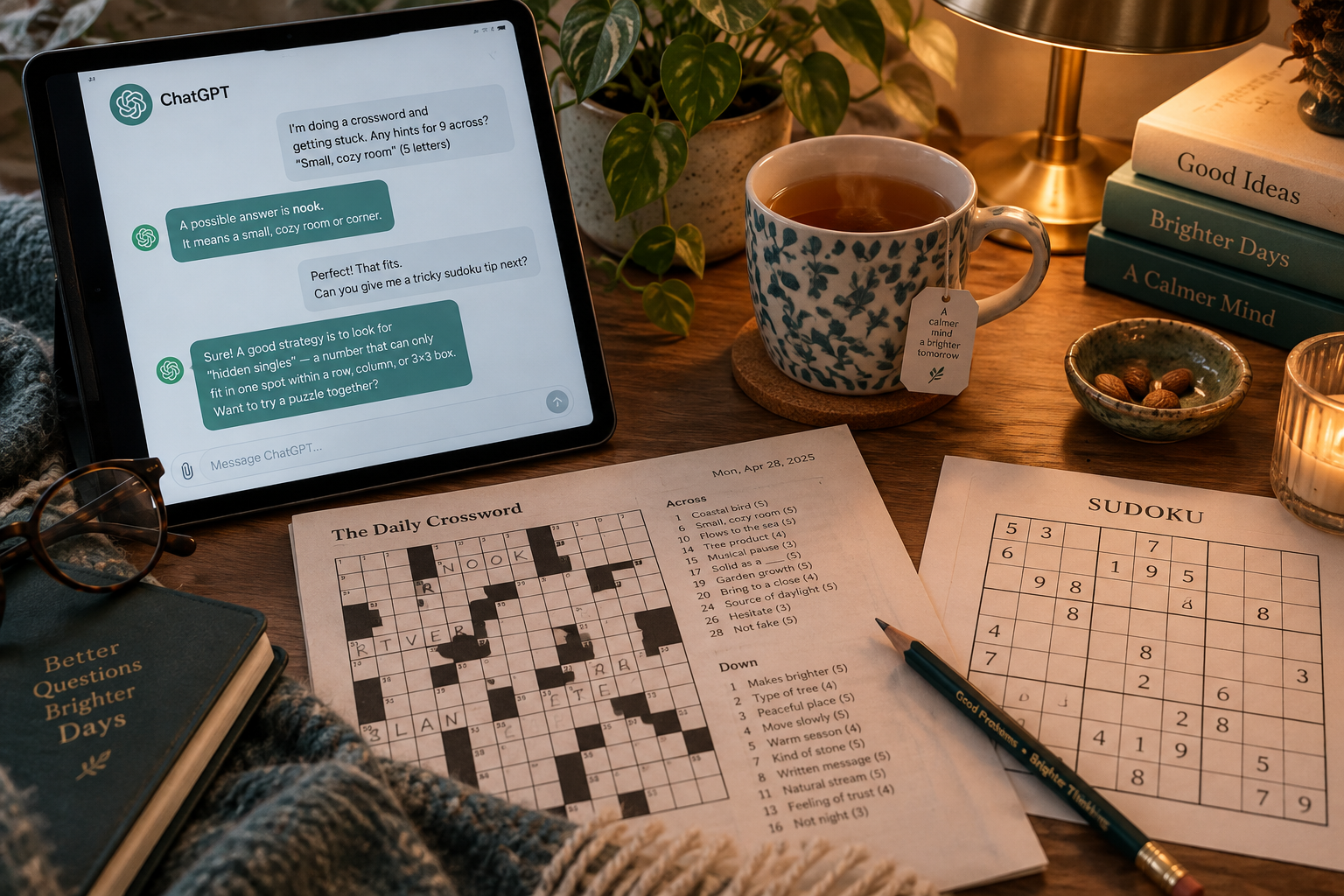
Claude for Puzzle Fans: A Smart Playmate, Not a Cheat Code
Curious how Claude fits into casual puzzle games? A practical look at where the AI helps with riddles, logic and hints — and where it quietly spoils the fun.
Somewhere between a crossword at breakfast and a logic grid at midnight, a new kind of puzzle companion showed up: a chatbot. Claude, the AI assistant built by Anthropic, was never designed as a game. It is a general-purpose language model that answers questions, drafts text and reasons through problems step by step. But that last ability — reasoning out loud — is exactly why puzzle players keep opening it in a second browser tab.
The appeal is easy to understand. Most casual puzzle games give you two choices: solve it yourself, or look up the answer and lose the satisfaction. Claude offers a third path — a nudge, a reframing, a quick “what rule am I missing?” conversation that keeps the puzzle yours.
What Claude actually is (and isn't)
Claude is a text-first assistant. You type or speak a question and it replies in paragraphs, bullet lists or numbered reasoning. It runs in a web browser and a mobile app, with free and paid tiers, and it handles long conversations well — which matters when you are fifteen clues deep into a puzzle and need it to remember the constraints you set earlier.
What it is not: a game engine, a scoreboard, or a database of official puzzle answers. It does not know today's Wordle word unless you tell it, and it cannot read your Sudoku grid unless you describe or upload it. Treat Claude like a well-read friend sitting across the table — one who never tires of “wait, explain that again” — rather than an answer key.
Where it genuinely shines
Riddles and lateral thinking
Ask for the reasoning behind a riddle and Claude will usually unpack the trick, including why the obvious answer fails. That explanation is often more valuable than the solution, because the same misdirection shows up in the next ten riddles you meet.
Word puzzles and anagrams
Language is Claude's home turf. It is useful for brainstorming anagram candidates, listing words that fit a specific letter pattern, generating themed crossword fill, or finding a five-letter word that fits three crossing clues. It is not a dictionary lookup — so double-check spellings — but it is a fast idea generator when your brain has gone blank on a single square.
Logic grids and rule-based puzzles
Describe your constraints in plain English — five people, five houses, the engineer lives left of the vet — and Claude can walk through deductions or check whether your chain of reasoning holds up. This is where the hint ladder really pays off: you can ask it to test one clue at a time instead of dumping the whole solution on the page.
Learning the rules of a new game
Casual puzzle portals are full of games with half-explained mechanics. Ask Claude to restate a rule set in plain language, invent a practice example, or compare two similar games so you know which one suits a five-minute break versus a long evening.
Where it stumbles
- Spatial and visual puzzles. Anything that depends on judging shapes, spotting differences in an image or mentally rotating a piece is a weak spot. Claude can talk about geometry, but it cannot reliably see it.
- Confident mistakes. Language models can produce a beautifully argued wrong answer. On puzzles with a single verifiable solution, treat every conclusion as a hypothesis until the game confirms it.
- Spoilers by default. Ask a loose question — “how do I solve this?” — and you may get the entire solution in one paragraph. Vagueness gets punished.
- Live daily answers. Claude does not have a live feed of today's Wordle, Connections or sudoku solution. Anything it “remembers” about today's puzzle is a guess, not a fact.
The hint ladder: how to ask without spoiling
The single most useful skill is requesting graduated help. A sequence that works well:
- “Don't give me the answer. Tell me what type of puzzle this is and what the standard tricks usually are.”
- “Give me one hint that narrows the possibilities without revealing the solution.”
- “I think the answer is X. Tell me whether my reasoning is sound, without confirming or denying X.”
- “Now walk me through the first two steps only, then stop.”
Each prompt keeps you in the driver's seat. It also produces better answers, because a specific question about a specific stuck point beats a vague request for help.
Fair play and the daily-game dilemma
Wordle streaks, sudoku times and leaderboard rankings only mean something if the solve was yours. Using an AI mid-attempt turns a personal challenge into a data-entry exercise, and most players figure that out quickly. A simple etiquette works: hints are for learning, not for finishing. Once a puzzle is done — solved or abandoned — Claude becomes a genuinely good study partner, explaining the technique you missed so the next one goes differently. And whatever you do, don't paste spoilers into a group chat.
Making your own puzzles
The most underrated use is creation rather than solving. Ask Claude for a themed mini crossword, a batch of ten riddles with answers, a small deductive logic grid, or a word ladder that runs from COLD to WARM. It is an excellent warm-up exercise and a way to practise a puzzle type you find difficult. Check the output before you share it, though; generated puzzles occasionally contain duplicate answers or clues that don't quite hold.
The bottom line
Claude is not a replacement for casual puzzle games and it is not a shortcut worth taking. It is a patient, endlessly available coach — strongest on words, riddles and deductive reasoning, weakest on anything visual, and always worth a second look before you trust it. Used with a hint ladder and a little restraint, it can turn a frustrating dead end into the most interesting five minutes of your puzzle habit.