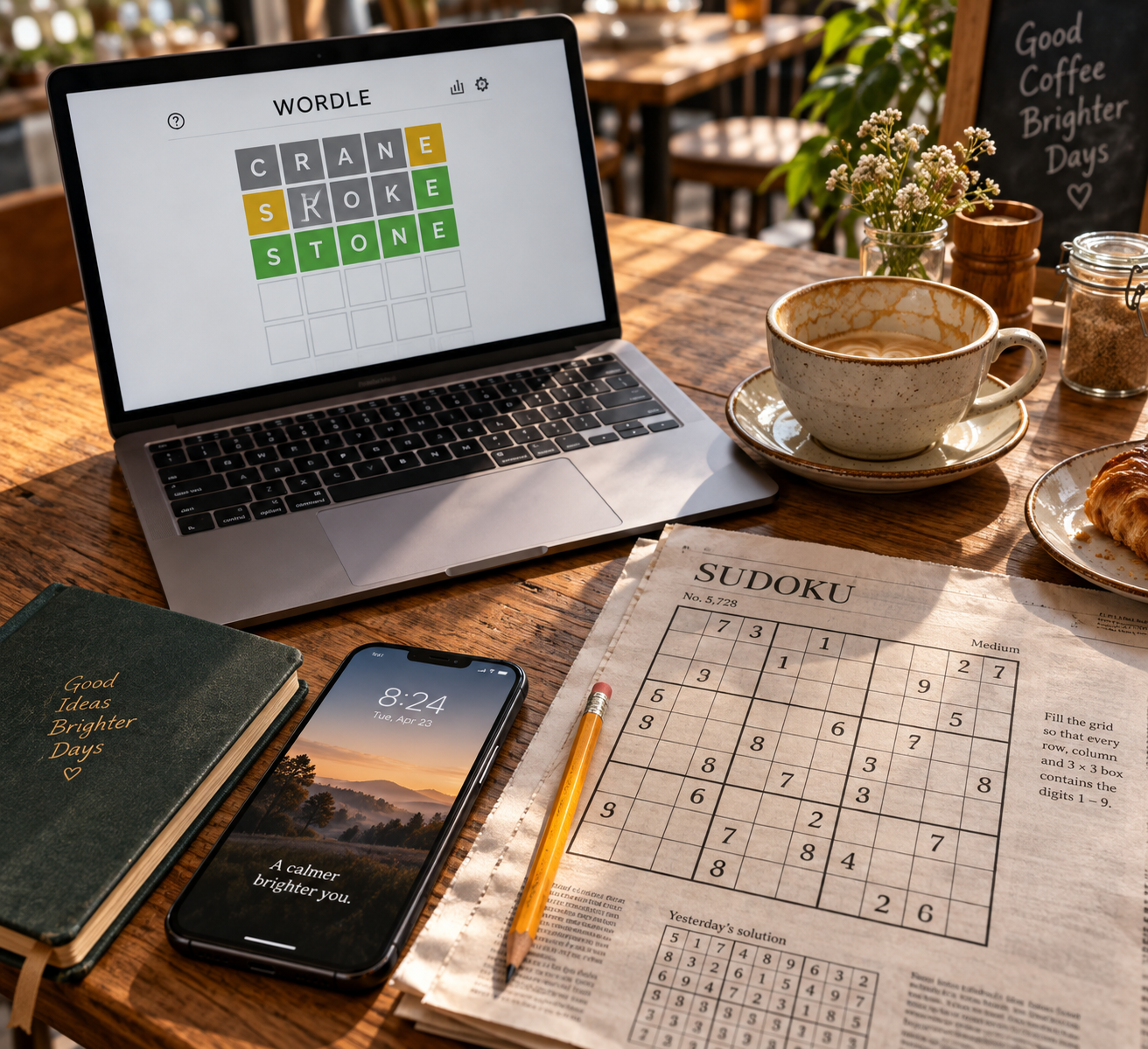
Daily Puzzle Rituals: Why Wordle and Sudoku Hook Your Brain
Daily puzzle games like Wordle and Sudoku tap into streaks, novelty and tidy completion. Here's the psychology behind the habit — and how to play well.
Somewhere between the first coffee and the first email, millions of people open the same tab they opened yesterday. They type a five-letter guess, watch the tiles flip green and yellow, and feel a small, disproportionate flicker of satisfaction. Then they close the tab and get on with their day. It is one of the quietest rituals in modern digital life, and it has quietly reshaped the casual puzzle game.
The daily puzzle is not a new idea — newspapers have printed crosswords and Sudoku grids for decades — but the browser-based, once-a-day, share-your-score format turned a private pastime into a shared social moment. Understanding why it works says a lot about how our brains respond to puzzles, and how game designers borrow those levers to keep us playing.
The rise of the five-minute puzzle
Casual puzzle games occupy a specific niche: low commitment, high clarity, no tutorial required. Match-three grids, hidden-object scenes, jigsaw apps and logic puzzles all share a design promise — you can understand the rules in ten seconds and stop at any point.
What changed in the last few years was the packaging. A once-a-day puzzle creates scarcity. Where a match-three game offers infinite levels, the daily grid offers exactly one, and then it's gone. Scarcity turns a game into an appointment, and an appointment turns a game into a habit. Wordle's explosion in late 2021 — followed by its acquisition by The New York Times in early 2022 — demonstrated that a plain grid of squares could outcompete glossy productions with entire art departments.
Why streaks are so persuasive
Behavioral research offers a few overlapping explanations for why a streak counter feels so heavy in the hand.
- The Zeigarnik effect. Unfinished tasks linger in memory more insistently than completed ones. A puzzle you haven't solved yet nags at you; a streak you haven't extended nags harder.
- Loss aversion. Losing a 200-day streak feels roughly twice as bad as gaining a day feels good. Designers know this, which is why the streak counter is usually the largest number on the screen.
- Variable reward. You never know if today's puzzle will be easy or brutal, and unpredictable payoff is far stickier than predictable payoff.
- Social proof. The shareable result grid — squares without spoilers — lets players brag, commiserate and compare without giving anything away. It converts a solo activity into a group ritual.
None of these mechanisms is sinister on its own. Combined, they are extremely effective, which is precisely why the same patterns show up in apps with far less benign intentions.
What casual puzzles actually do for your brain
The honest answer is: something, but less than the marketing suggests. Puzzle games reliably train task-specific skills. Regular Sudoku players get faster at Sudoku. People who play a particular memory game improve at that memory game. What the evidence does not support is broad transfer — solving a daily grid will not meaningfully raise your IQ, prevent dementia, or make you better at your job.
What puzzles do offer is real and worth naming:
- A closed problem with a clean ending. In a day full of ambiguous tasks, a puzzle has a right answer and a finish line.
- Low-stakes focus. The mild absorption of a puzzle is a genuine mental break from open-loop anxiety, similar to what people get from knitting or washing dishes.
- A shared reference point. Group chats and office kitchens run on the day's puzzle. That small common ground matters.
The design tricks behind “just one more”
Free-to-play casual games are engineered differently from a once-a-day newspaper-style grid. If you have ever played a match-three game and felt your time evaporate, you met the following:
Energy systems and lives
Play is gated. You get five lives; a mistake costs one; refills take time or money. The gate is designed to make each session feel scarce and each return feel earned.
Near-miss framing
Levels that end “so close” to completion are more likely to be replayed than levels that end in a clear failure. Designers tune difficulty curves accordingly — sometimes with a nudge toward a paid booster.
Variable difficulty and streaks
Win streaks that multiply rewards push players toward longer sessions, and a broken streak creates a strong pull to rebuild it immediately.
These are not moral failings of players. They are standard, well-documented engagement mechanics, and recognizing them is the most practical defense against them.
Playing well without turning it into a chore
A few habits keep casual puzzles in the pleasant-hobby zone rather than the compulsion zone:
- Keep one daily puzzle, not six. Rituals are relaxing; a checklist of six daily grids is unpaid work.
- Break a streak on purpose, once. Discovering that a 90-day streak can end without consequence is oddly liberating and loosens the streak's grip.
- Set the timer, not the goal. A 15-minute window is a boundary; “until I solve it” is not.
- Watch the ads, not the currency. If a game keeps asking for money to continue, that is your cue to close it.
- Prefer puzzles with a fixed daily endpoint. Once-a-day formats end themselves. Endless formats rarely do.
A small, honest pleasure
There is nothing wrong with a five-minute puzzle habit. It is cheap, portable, socially connective and mildly satisfying — a rare combination in an attention economy that usually asks for far more than it gives. The point is simply to stay the one who decides when the session ends.
The best casual puzzle game is the one that fits neatly between two other parts of your day and then steps aside. The green tiles are pleasant. The moment after them, when you close the tab and look up, is the part worth protecting.