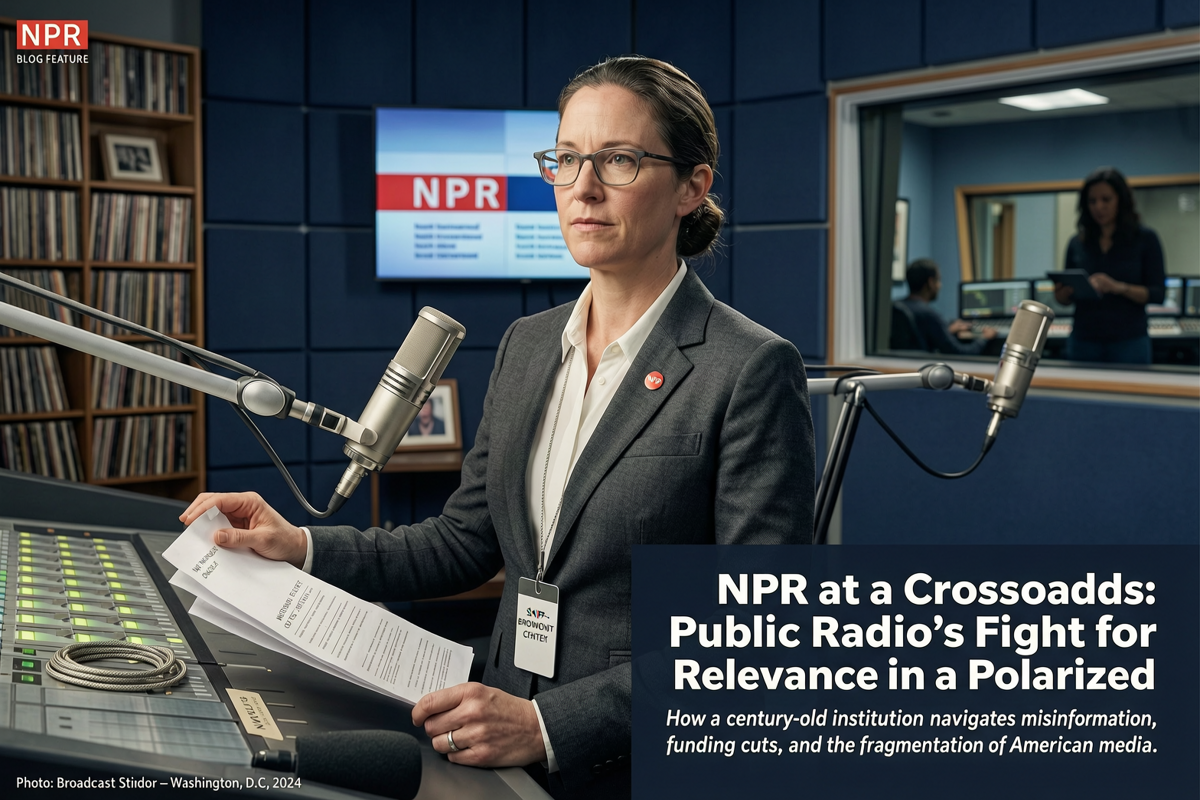
NPR at a Crossroads: Public Radio's Fight for Relevance in a Polarized
As NPR faces funding debates, audience shifts, and political pressure, its role as a trusted news source is more critical—and contested—than ever. An inside look at the challenges ahead.
A Public Trust Under Scrutiny
For decades, National Public Radio (NPR) has been a staple of American media, known for its in-depth reporting, thoughtful analysis, and distinctive audio storytelling. But in an age of political polarization, declining trust in institutions, and a rapidly changing media landscape, NPR finds itself at a crossroads. The network, which reaches over 60 million listeners each month through its member stations and digital platforms, is grappling with existential questions about its funding, its audience, and its very mission.
The debate over NPR's future is not new, but it has intensified in recent years. Critics on the right accuse the network of liberal bias, while some on the left argue it gives too much airtime to conservative viewpoints. Meanwhile, younger audiences are increasingly turning to podcasts, social media, and streaming services for news, challenging NPR's traditional radio model. And with the rise of artificial intelligence and algorithm-driven content, the network must innovate to stay relevant.
The Funding Conundrum
One of the most persistent controversies surrounding NPR is its funding. While the network itself receives a small portion of its budget from the federal government via the Corporation for Public Broadcasting (CPB), the vast majority of its revenue comes from member station dues, corporate sponsorships, and individual donations. However, the mere existence of federal funding has made NPR a target for politicians who argue that public broadcasting should not receive taxpayer money.
In recent years, proposals to defund NPR have been floated in Congress, though none have succeeded. Supporters of public broadcasting argue that the federal investment—roughly $1.50 per American per year—is a small price to pay for a service that provides educational programming, local news, and emergency alerts. They also point out that NPR's news coverage is often cited as more trustworthy than that of commercial networks. A 2021 Gallup poll found that Americans trust public broadcasting more than any other news source.
But the funding debate is not just about dollars and cents; it's about values. For many conservatives, NPR represents a liberal elite that is out of touch with mainstream America. For progressives, it is a vital institution that must be protected from corporate influence. This ideological divide has made NPR a flashpoint in the culture wars, with both sides using the network as a symbol of what they see as wrong with the media.
Audience Shifts and Digital Disruption
Beyond the political battles, NPR faces a more fundamental challenge: adapting to a world where fewer people listen to traditional radio. The rise of on-demand audio, from podcasts to music streaming, has eroded the habit of tuning in at a specific time for a specific program. While NPR has been a pioneer in podcasting—shows like Serial and Up First are among the most downloaded in the world—the shift to digital has created new pressures.
Younger audiences, in particular, are less likely to become loyal listeners of NPR's flagship programs like Morning Edition or All Things Considered. Instead, they consume news in bite-sized pieces, often through social media or personalized feeds. This fragmentation of attention poses a threat to NPR's model of curated, long-form journalism. To reach these audiences, NPR has invested in platforms like YouTube, TikTok, and Instagram, but the return on investment is not always clear.
Moreover, the rise of AI-generated content and deepfakes has raised questions about the value of human-produced journalism. NPR's commitment to fact-checking, source verification, and editorial judgment is more important than ever, but it is also more expensive. In an era of shrinking newsroom budgets, NPR must find ways to maintain its editorial standards while also experimenting with new formats and technologies.
Navigating Political Pressure
NPR's editorial independence has been tested repeatedly over the years. In 2022, the network faced backlash from both sides over its coverage of the COVID-19 pandemic, the 2020 election, and the January 6 insurrection. Some conservatives accused NPR of downplaying the Hunter Biden laptop story, while some progressives criticized its decision to air interviews with Trump administration officials. The network's ombudsman has frequently fielded complaints about bias, and internal debates about editorial direction have sometimes spilled into public view.
To its credit, NPR has sought to address these concerns through transparency initiatives, such as publishing its editorial guidelines and hosting listener feedback sessions. But the challenge of remaining neutral in a polarized environment is immense. As one former NPR editor put it, "In a world where everyone is shouting, the quiet voice of reason can easily be drowned out."
Another source of tension is the relationship between NPR and its member stations. While NPR produces national programming, the stations are locally owned and operated, often with their own editorial priorities. This decentralized structure can lead to conflicts, particularly when stations take positions that differ from the national network. For example, some stations have chosen to air programming from other sources, such as BBC World Service or local talk shows, that may not align with NPR's journalistic standards.
The Path Forward
Despite these challenges, NPR has several advantages that position it well for the future. Its brand is still synonymous with quality journalism, and its nonprofit status allows it to focus on public service rather than shareholder value. The network has also made strides in diversity and inclusion, both in its hiring and in its coverage. In 2023, NPR launched a new initiative to expand its coverage of underrepresented communities and to recruit journalists from a wider range of backgrounds.
Technologically, NPR is exploring ways to use AI to enhance its reporting without replacing human judgment. For instance, it has experimented with automated transcription and translation tools to speed up the production process. It is also investing in new audio formats, such as immersive soundscapes and interactive stories, to engage listeners in novel ways.
But perhaps the most important factor in NPR's survival is its relationship with its audience. In an era of fake news and information overload, listeners are hungry for reliable, context-rich journalism. NPR's ability to provide that—while also listening to and learning from its critics—will determine whether it remains a vital part of the American media landscape or becomes a relic of a bygone era.
As the network celebrates its 50th anniversary, it is clear that NPR is not just a radio network; it is a mission-driven organization that believes in the power of information to strengthen democracy. Whether that mission can survive the political and technological storms of the 21st century is an open question. But for now, NPR continues to broadcast, podcast, and stream, one story at a time.