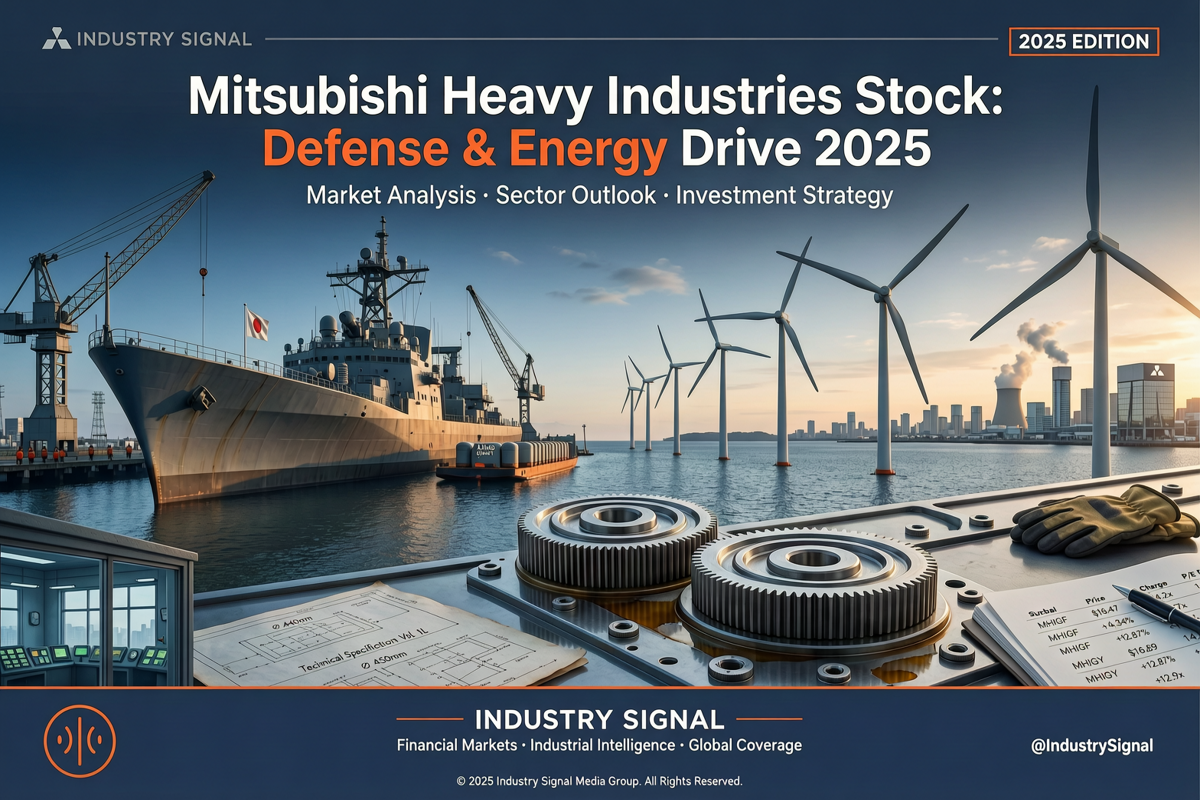
Mitsubishi Heavy Industries Stock: Defense & Energy Drive 2025
Mitsubishi Heavy Industries stock is surging in 2025 on defense contracts and green energy expansion. We analyze the catalysts, risks, and outlook for this Japanese industrial giant.
Mitsubishi Heavy Industries (MHI) has long been a cornerstone of Japan's industrial might, but its stock price is attracting renewed attention in 2025. The conglomerate, with businesses spanning shipbuilding, aerospace, energy systems, and defense, is riding a wave of government spending and global energy transition. After a period of relative underperformance, MHI shares have rallied sharply, outpacing the Nikkei 225. What's driving this momentum, and can it be sustained?
Defense Spending Boom
Japan's historic shift in defense policy is a primary catalyst. In 2022, Tokyo announced plans to double its defense budget to 2% of GDP by 2027, making it the world's third-largest military spender. MHI, as the nation's premier defense contractor, is a direct beneficiary. The company produces F-35 components, Aegis destroyers, and next-generation fighter jets. In 2025, MHI secured a major contract for the Global Combat Air Programme (GCAP), a joint venture with the UK and Italy. Analysts estimate defense revenues could grow 15-20% annually over the next five years.
Energy Transition Tailwinds
Beyond defense, MHI is positioning itself as a leader in the energy transition. The company's gas turbine and carbon capture technologies are in high demand. MHI's subsidiary, Mitsubishi Power, has secured contracts for hydrogen-ready gas turbines in Europe and Asia. Additionally, MHI is investing heavily in small modular reactors (SMRs) for nuclear power, a technology gaining traction as countries seek decarbonized baseload power. In 2025, MHI announced a partnership with a U.S. utility to deploy SMRs by 2030, boosting investor confidence.
Financial Performance
MHI's financials have improved markedly. For fiscal year 2024 (ending March 2025), the company reported a 12% increase in revenue to ¥4.5 trillion, with operating profit up 18% to ¥280 billion. The defense segment saw a 22% profit surge, while energy systems posted a 10% gain. The company's order backlog hit a record ¥12 trillion, providing strong visibility. MHI also raised its dividend and announced a ¥100 billion share buyback, signaling management's confidence.
Valuation and Risks
Despite the rally, MHI's valuation remains reasonable. The stock trades at a forward P/E of 15x, below the historical average for Japanese industrials. However, risks persist. The defense boom is tied to geopolitical tensions, and any easing could slow orders. Energy transition projects are capital-intensive with long payback periods. Additionally, MHI faces competition from global giants like General Electric and Siemens Energy in the power sector. Currency fluctuations also impact earnings, as MHI earns a significant portion of revenue overseas.
Technical Outlook
From a technical perspective, MHI stock broke out of a multi-year consolidation range in late 2024. The 50-day moving average recently crossed above the 200-day, forming a golden cross. Support lies at ¥4,500, while resistance is at ¥5,500. Momentum indicators suggest the stock is overbought in the short term, but the long-term trend remains bullish.
Analyst Consensus
Wall Street is overwhelmingly bullish. Of 15 analysts covering MHI, 12 rate it a Buy, with a median price target of ¥5,800, implying 15% upside from current levels. KeyBank and Nomura have recently upgraded the stock, citing defense and energy tailwinds. Some caution that the stock may have run ahead of fundamentals, but most see sustained growth.
Conclusion
Mitsubishi Heavy Industries is at the intersection of two powerful secular trends: rising defense budgets and the global energy transition. With a strong order book, improving margins, and shareholder-friendly policies, the stock offers a compelling risk-reward profile. While short-term volatility is possible, the long-term outlook appears bright. For investors seeking exposure to Japan's industrial renaissance, MHI is a name to watch in 2025.