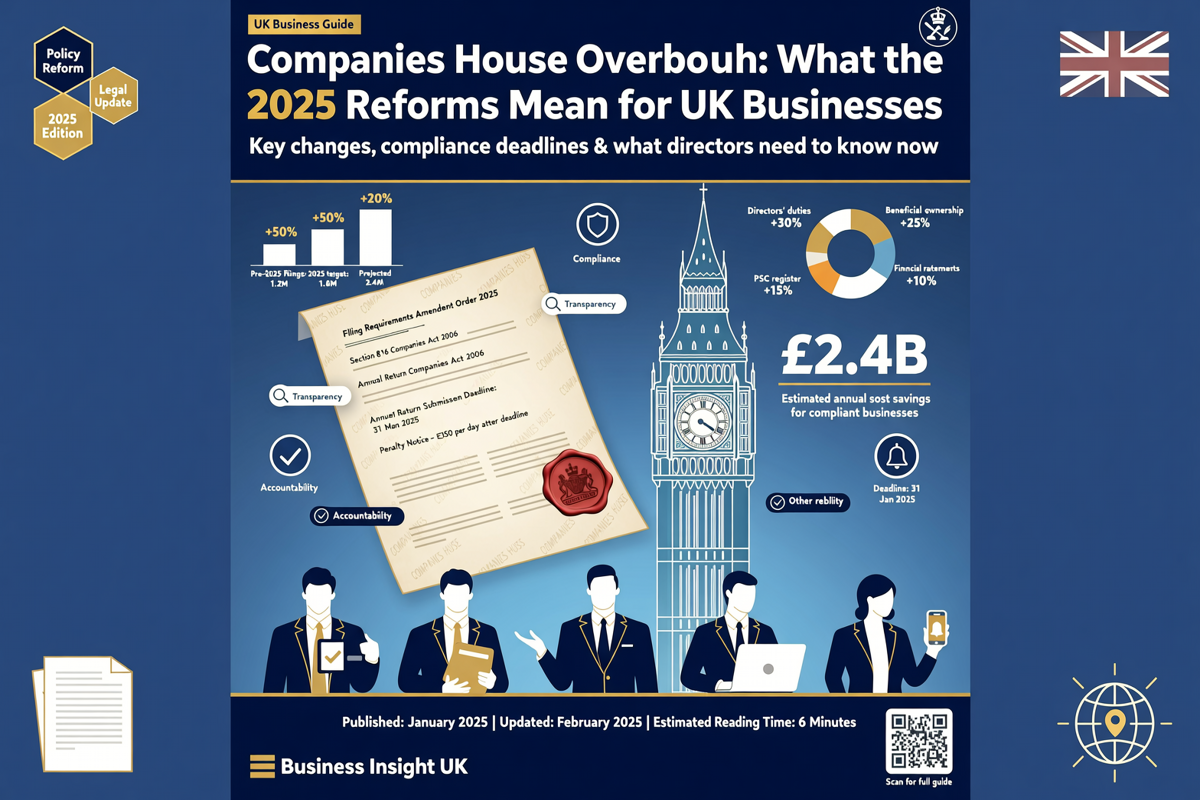
Companies House Overhaul: What the 2025 Reforms Mean for UK Businesses
The UK's Companies House is undergoing its biggest shake-up in decades. Learn how new identity checks, filing changes, and transparency rules will affect your business.
Introduction
For decades, Companies House has been the quiet backbone of UK business transparency, a repository where companies file annual accounts, confirmation statements, and director details. But in 2024 and 2025, this institution is undergoing its most radical transformation since its creation in 1844. The Economic Crime and Corporate Transparency Act 2023 is now being implemented, bringing sweeping changes designed to crack down on fraud, money laundering, and opaque ownership structures. For business owners, accountants, and company secretaries, these reforms will reshape how they interact with the register. This article breaks down the key changes, what they mean for your business, and how to prepare.
Why the Reform? The Problem with the Old System
The old Companies House was often criticised as a 'passive recipient' of data. It checked that forms were completed correctly but did not verify the accuracy of the information. This allowed criminals to register companies using false addresses, stolen identities, or fictitious directors. According to government estimates, millions of pounds in fraud were facilitated by the lack of verification. The new regime shifts Companies House to a proactive gatekeeper role, with powers to query, reject, and even strike off companies that provide false information.
Key Changes in 2025
Mandatory Identity Verification
From early 2025, all new directors, persons with significant control (PSCs), and anyone filing documents will need to verify their identity. Existing directors and PSCs have a transition period (likely 12-18 months) to complete verification. This can be done online via a GOV.UK One Login or through an authorised agent, such as an accountant or company formation agent. The aim is to ensure that every person connected to a company is a real, identifiable individual. Failure to verify will result in the company being unable to file documents and could lead to strike-off.
Restricting Corporate Directors
Corporate directors (i.e., a company acting as a director of another company) are being significantly restricted. From a date to be confirmed in 2025, companies will only be allowed to have corporate directors in limited circumstances, such as when the corporate director is itself a company with all natural-person directors who are verified. This change targets the use of opaque corporate structures to hide true ownership.
Stronger Powers to Query and Reject
Companies House now has the power to query information that appears inconsistent or suspicious. It can reject filings, require corrections, and even annotate the register to warn users that information may be unreliable. This is a major shift from the previous 'file and forget' approach. For example, if a company changes its registered office address to a residential property that is clearly a mailbox service, Companies House may ask for proof of the address's validity.
Changes to Annual Accounts and Filing
There are also changes to what companies must file. Small companies will no longer be able to file abridged accounts (which disclose minimal information). Instead, they must file either micro-entity accounts or full 'small company' accounts, which include a profit and loss account and a balance sheet with more detail. This increases transparency but also adds to the filing burden for small businesses. Additionally, the deadline for filing accounts for private companies is being reduced from 9 months to 6 months after the end of the accounting period, phased in from 2025.
Registered Office and Email Address Requirements
Companies must now have an 'appropriate address' as their registered office – one where documents can be physically delivered and received by a person acting on behalf of the company. PO boxes are no longer acceptable. Furthermore, companies must provide an email address to Companies House, which will be used for official correspondence. This email will be published on the register, so businesses should use a generic company email rather than a personal one.
Impact on Businesses and Accountants
For most legitimate businesses, these changes will mean more admin initially but greater trust in the business environment in the long run. Accountants and company formation agents will play a crucial role in helping clients verify their identities and understand new filing requirements. The shift to shorter filing deadlines for accounts will require better financial record-keeping and earlier preparation. Companies that have historically used 'shelf companies' or complex corporate structures for legitimate purposes will need to review their arrangements to ensure compliance.
How to Prepare
Start by ensuring that your company's registered office address is a physical location where documents can be received. If you use a virtual office, confirm that it meets the new 'appropriate address' criteria. Next, gather the personal identification documents for all directors and PSCs – a passport or driving licence will be needed for online verification. Consider setting up a GOV.UK One Login account now to streamline the process. Finally, review your accounting period and plan to file earlier. If you currently file abridged accounts, speak to your accountant about switching to micro-entity or small company accounts.
Conclusion
The Companies House reforms represent a significant step forward in corporate transparency in the UK. While they impose new obligations on businesses, they also promise to reduce fraud and make the register a more reliable source of information. By understanding the changes and preparing now, your business can navigate the transition smoothly and continue to operate with confidence in the UK's business environment.